Thursday, July 3, 2014

It's still a clever idea.


 Have any of you heard of Christine? You may think of the car that killed people, I think of my friend's ex who we think also killed people, but in this case we should be thinking of a very clever idea for PC design by none other than the purveyors of premium performance PC peripherals, Razer.

Well known for their outstanding, competition-grade mice and keyboards, they decided they would get into the custom PC market with the concept of a modular PC they dubbed project Christine. It's a unique idea for a PC, in that whatever you need to add or swap out can be done so with modules that are easily replaceable, and adding or removing one doesn't affect the rest of the PC or require complex installation. Not only that, it's fanless and silent thanks to its liquid cooling.

The concept of modularity is not new, in fact Google is right now working on a cell phone with a similar modular design known as Project ARA, which allows the user to upgrade parts as necessary; for example you could upgrade the camera just by swapping out the module rather than replacing the whole phone. If it can work there, it makes just as much sense for a PC. Plus, Razer's concept just looks incredible - a true vision of the future. Here is a great video that goes into great depth about the machine.


Unfortunately, it also looks like it is now on indefinite hold. Apparently, in order to get it designed and built Razer would have to partner with other PC manufacturers, however those PC manufacturers are, according to Razer CEO Min-Liang Tan, more interested in selling what they have rather than designing something new.

That's too bad. I love this concept and want to see it succeed. The language used is dire, but not terminal, so I will hold out the thinnest sliver of hope. In the meantime, I am more excited about their Nabu project than I am about any other wearable tech. So I'll latch on to that instead.

Wednesday, July 2, 2014

Happy 35th birthday to the Sony Walkman!


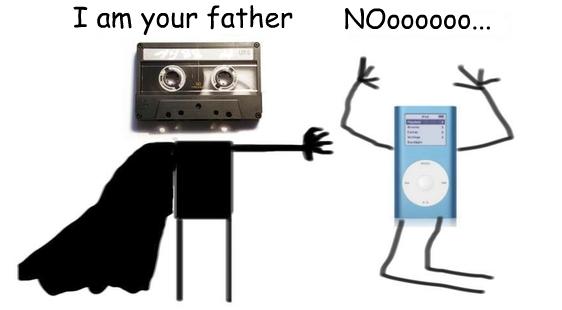
The Sony Walkman, precursor-of-sorts to all things portable-audio, turns 35 years old today! Back in the glory days of '80s analog audio - which is still alive today since analog is a superior sound reproduction process than digital as we will learn - walking around listening to Iron Maiden on cassette with a Sony Walkman was the ultimate yet understated way to let everyone else know you were cool.

ipod-cassette-tape-funny

They went beyond being simply a music listening device. Some had very advanced features, some looked like they were waterproof (but weren't), and in the ultimate proof of their dominance, they became a fashion statement, especially for exercising (that was actually the image on the box the player came in). Their ultra-creepy ads couldn't put a damper on that. I had one and loved it. I may still have it around somewhere; my garage is the technology version of the Island of Misfit Toys.

They never skipped, something that happened with early portable CD players and hard-disc based digital music players, but since they were mechanical there was always the risk of an eaten tape. You can buy digital media players that still bear the Walkman name, but I'm not confident of their quality.

A couple of side notes: it appears that cassettes might be making a comeback, and the video below shows that backwards, technologically-deficient kids these days have no idea how to operate even the most basic of machines. Get those kids some technology!

Tuesday, July 1, 2014

Welcome!


Welcome to IS301! As you should know by now, this is the blog to which I make posts about all aspects of technology, whether it be regarding its impact on society or us as individuals, how technology is used in business, robotics, security, mobile technology, law, policy, prosthetics, history (this deserves its own post, I love seeing early predictions of what today would be like), ethical use of technology, anything technology related is fair game.
I used to use this Blogger platform here at is301fornsc.blogspot.com, but you knew that because you're here now. Now, however, I have transitioned to the Wordpress platform, with the website located at is301atnsc.wordpress.com. I have been making dual posts to both sites because the Blogger site has so many followers, so I will likely continue to make dual posts to both sites while I use this summer class to determine which platform is ultimately better as an educational tool. It is the Wordpress site that will be used for comments and guest posts for the summer session, however. If it is successful, I will most likely give it its own domain (www.is301atnsc.com or something like it) which will give me much more flexibility.
You will need to register with Wordpress in order to make comments on posts, which is a requirement of the class as laid out in the syllabus. I will talk more about it in class, and I will also allow students to make guest posts for a little extra credit (not too much!).
Beyond that, if there is something you feel is interesting - a news story, a personal experience, if you have a question or would like more clarification about something related to technology, let me know I will be more than happy to consider making a post about it.
You'll learn a lot through this blog. You'll be surprised!

Monday, June 30, 2014

Old school pixel art, modern animation technique

(Wordpress site here, and summer classes begin Tuesday so I'll have to decide whether to keep making dual posts. I probably will while the site is live for students just so I can see how it works out)
This post will tax some of your machines, but it's worth it - I promise. In searching for the coding behind Atari's well-known color-cycling routine, I discovered a fascinating webpage that uses the HTML5 specification (a version of the language in which web pages are created) and a more technical but plain-text standard known as JSON to animate a series of old pixel-art images with color cycling.
03 - ngqNfvjTo give you the basic idea, color cycling allows for the shifting of an image's palette of colors, with each pixel cycling through the colors that are nearest to it in the palette, giving the illusion of motion. It might not sound like much, but the results are spectacular. Unlike traditional animation, the image itself is not actually changed in any way; it remains a single image, only the pixels are cycling through different colors - the images in this post are animated gifs, however on the linked webpage you'll see the same images with many others but they are not animated, their movement is an illusion created by shifting colors! The site gives a very good example of it being similar to how movie marquee lights give the impression of movement, when they are simply turning off and on at very specific intervals. 
01 - xNwyDSX
When you visit the site, you can launch the images with sound or without, and you can alter some parameters such as zoom and cycle speed, as well as see the actual palette cycling through the colors; it's spectacular and the pictures are stunning. I have linked to the main website of the person who developed the animations, but it appears they are based off of Amiga files from years ago (although it states they were created in DOS with DeluxePaint. I had an Amiga, so maybe I'm getting platform and format mixed up) originally created by Mark J. Ferrari. If you're familiar with the old LucasFilm games such as Loom which was mentioned in the Q&A with Mark, or similar games like Indiana Jones and the Fate of Atlantis or The Secret of Monkey Island, Mark did work for Lucasfilm Games in their heyday when those titles were popular. 
(Incidentally, if you're interested there is a version of The Secret of Monkey Island and its sequel in the iTunes app store, that allows you to swipe to shift between the original pixel-art and brand new watercolor-quality graphics. One of the best apps I've ever seen).

Friday, June 27, 2014

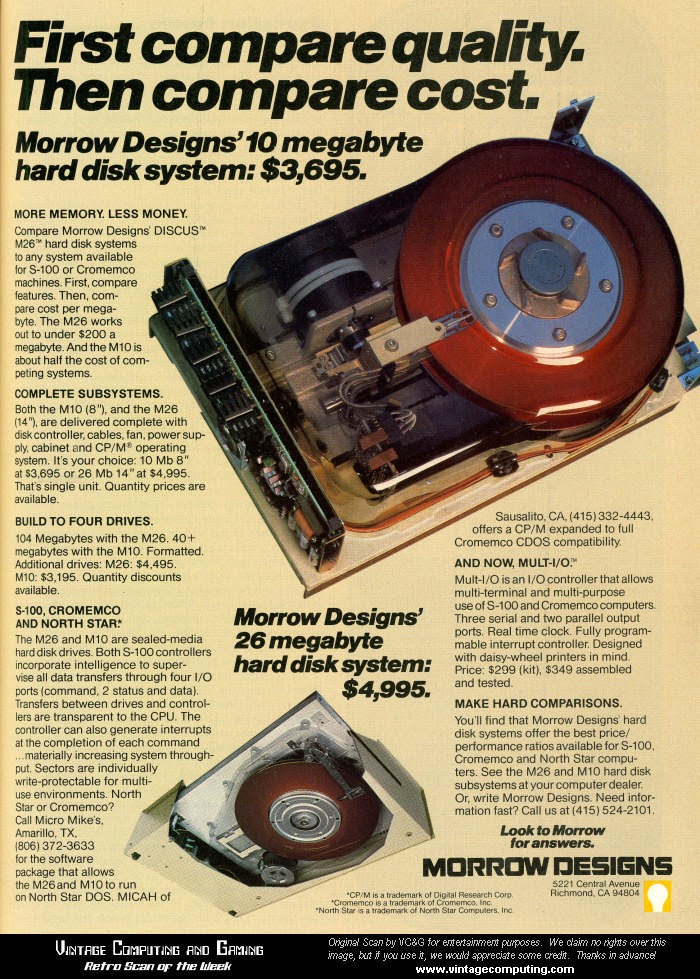
Think hard drive space is expensive?


(Wordpress site here)

Another history-type post here, but I have to begin by stating that I have been thinking about adding a very high-capacity NAS, or Network Added Storage, drive to my system at home. They're expensive, but they can serve as your own personal cloud and recover all your data without interruption in case of a crash. They also connect to a router as opposed to a PC so they can share data to all devices on a network, or in fact devices all over the world if they have the proper permissions. You can read more about them at this link.

Storage is important today, but in the glory days of the '80s it was at an absolute premium. Just to give you an idea of the level to which that was true, have a look at these couple of ads for 10 MB hard disks from way back when, meaning the 80s (the first and third are from vintagecomputing.com, a great site!).


It's all over for Aereo


(Wordpress site here)

I suspected it would end like this, but hoped that it wouldn't. On Wednesday, the Supreme Court sided with broadcasters who had filed a lawsuit against Aereo, a company whose business was to rent you a tiny, dime-sized antenna that resided in their facility, which would in turn stream broadcast network television to your house over the Internet. For $8 a month, you could not only watch the video but record it as well. Below is a diagram of how it works, from deadline.com, which has a thorough and comprehensive Q&A about the company and how it ended up in front of the Supreme Court.

Aereo-info-graphic__140414141536 
In effect, Aereo was claiming that because the streams are free in the first place, they are not violating any copyright laws. They're right on the first part, of course; in fact you can attach any number of broadcast antenna to your house and get network TV for no charge. The broadcasters, however, claimed that it was a violation of copyright law since cable companies are legally bound to pay networks for their content. The Supreme Court agreed, stating in a 6-3 decision that there was no difference between Aereo and a cable company. The dissenting judges stated that because it was the consumer who was doing the watching and Aereo was simply acting as a middleman, the company was not violating any copyright laws.

Again, I suspected this would happen but I'm sad that it did. I cut the cable cord a long time ago, and since all local news streams online anyway and I don't follow sports (not to mention my spectacular digital media center), it hasn't been a big deal. But I am someone who believes that many big media companies are clinging too tightly to old business models and they should have found a way to work with Aereo and companies like it to move their business practices and channels forward, rather than continue the pattern of sue-sue-sue. It didn't work with record labels, whom I actually sided with, and I imagine it won't work for TV for too much longer.

Also, while researching this article, I found this picture on tapscape.com, which has some good infographics about Aereo, as well as a post that pulls no punches regarding their opinion on the whole thing. In light of the decision, it gave me quite the chuckle.

aereo-supreme-court-decision

One other thing: There are some claims being made that this verdict against Aereo means that the floodgates will open for larger legal actions against cloud services in general. I don't believe that will happen as Aereo was a specific case and the cloud is so vast, integrated, and critical that it will maintain its existence as it is. If not, well, it would be the Internet equivalent of this.
If you are interested in seeing the court's point of view and why they decided the way they did, you can read their full decision in .pdf form here.

Monday, June 23, 2014

Unbelievable real-time map of global hack attacks


(Wordpress version here. As an FYI, I am now composing all posts in Wordpress, and simply copying them over here.)

Norse Technologies, one of the leading network-security and monitoring companies, has released an absolutely mesmerizing global map that shows, in real time, global hack attempts, including the type of hack, the origin of the hack, and the intended target. That's a picture of it in the header, and while writing this post I also was fortunate enough to witness a massive, coordinated attack that you can see in the image below. Fun!

Screenshot (92)

You can hover over any on-screen element top get more information about that particular attempt. Norse achieves all this by using its own honeypot infrastructure. A honeypot is a type of server that sits between the Internet and a company network, and is intended to look like a regular server on said network. However, it is actually specifically designed to attract hack attempts and fool the attacker into thinking they have successfully gained access to a system or network, all the while while monitoring the attempt and gathering as much information as it can in order to learn about network vulnerabilities or to gather information for a potential prosecution. Honeypot servers can be deployed in several ways, however it is not uncommon for them to have a small amount of actual corporate data on them to maintain the ruse for as long as is required.
As you can see, honeypot software can perform a huge amount of monitoring tasks
They also mention they are following darknet attacks, but I don't know why that would be necessary. Darknets are networks that run underneath the Internet, using virtual private networks and tunneling protocols and things of that nature to avoid detection and access (Silk Road, in the news a lot recently, was a darknet used to traffic weapons, drugs, in some cases even people), but there are enough regular attacks that darknet monitoring wouldn't be necessary. I suspect their use of the term is representative of their own network of honeypot servers.  

NOTE: I could only get the site to run smoothly in the Chrome browser, and it's worth downloading just for this. It worked in Internet Explorer and Firefox after a refresh, but very slowly, so be aware.

Friday, June 20, 2014

Athletic scholarship available for playing League of Legends


(Wordpress version here)

It has finally happened. At Robert Morris University, a college in Illinois, the computer game League of Legends is now considered a varsity athletic sport and scholarships are being offered to exceptional competitive players, something they trumpet on their home page.

The fact that it's considered varsity is important; that means students recruited to play the game for the university are considered athletes, complete with the benefits and considerations that entails, including tutors, financial aid of up to 50 percent off tuition and room and board, leave from class for tournaments, and so on.  The college will be recruiting three teams of nine players each.

There are other teams at other universities who play against each other in an unofficial league known as the Collegiate Star League, but this is the first time the game has been officially sanctioned and its players formally considered athletes.

 Yes, that is a computer gaming competition.
On its face it sounds ridiculous, but "e-sports" as they are called are actually a huge business, with competitive matches drawing thousands of spectators and tens of thousands more online, complete with commentators and analysts. Professional computer and video-game players have been around for a long time, and in recent years it has become very well organized, and more importantly, lucrative.

I personally don't follow any sport except when the Oilers are playing, and I'm not much of a gamer, so I make no comment as to the legitimacy or validity of the offering. But with the video game industry being one of the most influential in tech and pop culture, bringing in $20 billion a year in revenue (and that was in 2008!), then why not? if golf can be a sport, why not electronic games? Indeed, this may help push it even further into the mainstream, and help schools that host similar teams to consider them the same.

Thursday, June 19, 2014

It's either not a big deal, or the end of the world.


(Wordpress version here)
As some of you know, about two months ago I deactivated my Facebook account. I desperately needed a break from all the passive-aggressive posts that cried out for attention yet gave no details (you know, posts like "Well this sucks"), the posts that pleaded with me to "please like and share," which come across as a desperate cry for validation, and the Foursquare check-ins whose purpose I have yet to understand, but thanks for telling me no one's at your house for the next two hours. I don't actually have anything inherent against Facebook, I used it to keep in touch with friends and colleagues from around the world, I just needed a break. Apparently if I log back in everything will come back. I don't know if I ever will, but never say never. 
Anyway, apparently Facebook crashed on Thursday morning for about 30 minutes, making the service unavailable worldwide for millions and millions of users. People began to panic; almost immediately the (sigh) hashtag #WhenFacebookWasDown shot through the roof, and people started posting to rival social media sites such as Twitter and Google+ asking if it was the apocalypse, the rapture, and stating they'd always remember where they were when Facebook died. That, incidentally, led to some hilarious tweets.
capture-1-522x293
Did you see this screen? It's ok!
As the article states, some pseudo-over-reactionary named John Pudny facetiously lost his mind, tweeting "It's the end of the world...#Facebook is DOWN!!" I don't think media reports on that particular tweet, which was widely quoted, picked up on the troll nature of that tweet. 
That all happened within 30 MINUTES! It's not a big deal if a website crashes, people, especially one as massive and non-critical as Facebook. You can go half an hour without it, everyone survived the outage last October when the site went down for hours due to maintenance. It was not a disaster of biblical proportions, there was no human sacrifice, dogs and cats didn't start living together, but there was plenty of mass hysteria. Now that it's back up, please like and share this post.

Prototype Integrated Circuit up for Auction (for $1 million plus!)


(Wordpress version here)
A prototype of the original integrated circuit developed in 1958 by Jack Kilby at Texas Instruments, and for which he won a Nobel Prize decades later, is going up for auction at the prestigious Christy's auction house in London and is estimated to bring $1 to $2 million. The integrated circuit was one of the most important inventions in electronics, allowing multiple components such as switches and transistors on a single chip. Today's computer chips, which are evolutions of the original integrated circuit being auctioned, have *billions* of components which provides for incredible speed and smaller devices.
The integrated circuit was the foundation of the establishment of Moore's Law, in which Gordon Moore, a co-founder of Intel, stated that the number of components that could fit on an integrated circuit would double approximately every eighteen months to two years, depending on who you ask. That law, which has expanded to refer in a general sense to the evolution of technology itself, has held true ever since, even with naysayers aplenty, including one from Intel itself!.
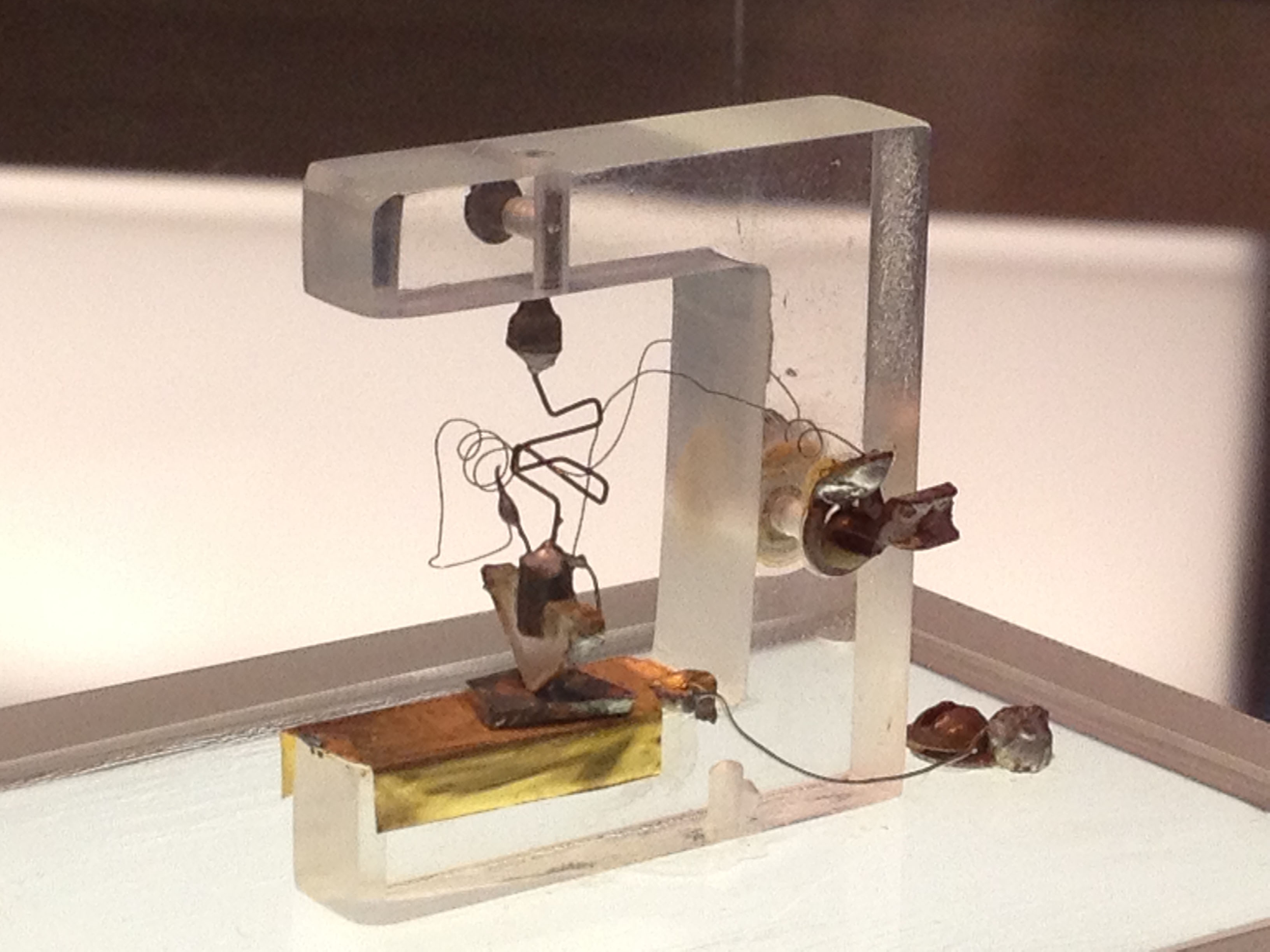
To be fair, the most important invention in electronics was the Nobel Prize-winning development of the transistor itself by William Shockley, John Bardeen, and Walter Brattain in the late 1940s; the integrated circuit wouldn't have been possible without it and we would still be using vacuum tubes in computers that were as big as a whole room. It too went through a massive evolution as you can see from the images below: The first is the original transistor they developed, the second is a transistor from today. Progress!
1st-Transistor
The First Transistor
Transistor-photo
Transistors Today
Even so, I am overjoyed that a piece of computing history is expected to bring in so much, it shows that the history and development of technology has value and is appreciated.
On a side note, I was going to link to this article on Engadget that talked about the auction, but it was so badly written I had to find another. I couldn't even bring myself to use their header image, I had to borrow from hungeree.com instead.