Saturday, February 1, 2014
Related to the Twitter-hack story.
Remember the post about the person who had been offered $50,000 for his Twitter handle @N, but that had his websites held hostage thanks to a social engineering attack that forced him to hand over the handle? And remember how he had a conversation with the attacker who described the plan in detail? It's like something out of a Scooby-Doo cartoon.
Well here we go again! On the same site, Ars Technica, is a story from someone else who has the Twitter handle @jb, apparently in high demand by Jonas Brothers and Justin Bieber fans to the tune of $500,000, came under social-engineering attack as well when he started receiving a bunch of emails from Amazon that were password-reset requests.
Unlike the previous story, he was able to (barely) intercept the attack and prevent it, but it's a good read and offers some good advice for security. You can never have 100% security,but you want to be as close as possible.
Hang onto those Twitter handles!
Friday, January 31, 2014
Uh oh, Sony. Get it together.
To be fair to Sony, they are a huge organization and not designed for agile shifts in direction. Additionally, their products, while outstanding in terms of build quality and design, are premium. Apple can afford to do that, Sony can't. They have already scaled back production of TVs, and sold their spectacular building in NYC for over $1 billion. Even with that massive sale, it's a short term solution.
I have faith in Sony. They need to shift into the D&S much more heavily than they are now, and really push their tablets, phones, and even laptops. They're all top-tier products but the company is too big to be kept afloat by TVs and consoles alone.
Thursday, January 30, 2014
The value of virtual goods and money.
This is one view of a huge EVE Online battle. I have no idea what's going on.
Two stories for this post that address something we'll be talking about later in the semester; virtual goods that have cost real time and real money, and the very timely topic of security.
The first story involves online game EVE Online that takes place in a vast universe. In this game, players build and pilot ships, mine for materials, form and join alliances and corporations, and engage in space battles. The catch is, everything happens in real time. If something says it will take "3 days" to complete, it will take three actual days. Some things take much longer, up to months. And in a curious twist, in game currency, known as ISK, can be used for real-world items.
Recently, a huge battle erupted in this online universe, over an unpaid in-game bill no less, that is estimated to have cost the equivalent of $500,000 (UPDATE: $570,000). As the article states, one of the consequences of this battle was the destruction of what are known as Titan ships, worth about $3,000 dollars each in terms of time investment, and take real-world months to build. The currency in EVE Online, as is the case with other virtual worlds, has a real-world exchange rate, although much of it is calculated through time invested. Second Life, referenced in the above link, has a virtual economy linked much more closely with the real world. Even so, players take their ISK seriously, with a huge scandal erupting when a 200 billion-ISK heist happened back in 2008.
I am only familiar with EVE Online through third party sources, so if anyone knows more about it be sure to fill us in in the comments!
That sets us up for the next story which is much more serious, and has implications that are much more far-reaching than even outer space, virtual as it may be.
In this case, Twitter user Naoki Hiroshima, whose Twitter handle was the very in-demand '@N,' was subjected to a social-engineering attack. He had been offered as much as $50,000 for that handle in the past, and attempts to steal it have been tried before as well. However when hackers used the very non-technical social-engineering approach, they finally got through. Convincing PayPal to release the last four digits of his credit card number to them, they then used that to take over all his web sites at GoDaddy and held them hostage. In order to get those domains back, he ended up handing over the details for his @N Twitter account.
A full account of the attack, it's resolution, along with an unparalleled and mesmerizing conversation with his attackers, can be found at this link. It's a fascinating, educational, and scary read.
UPDATE: Hmmmm.
Wednesday, January 29, 2014
The Opera Browser
I know everyone has the browser they prefer, and it's never the Opera browser. Opera is actually *my* browser of choice; I'm using it to type this right now! I'm a big fan of the configurability of it, the speed dial screen that lets you click right to favorited sites, the button that lets you return to Speed Dial from anywhere, the search bar right on the main screen, the discover screen that summarizes news for the day, thumbnails of bookmarked sites (although no organizing those which is frustrating), almost everything about it is a positive for me.
So I saw this article yesterday talking, somewhat snarkily, about an upcoming version release of the browser, and I'm glad to see it is still moving forward considering it's a very small slice of the browser-market pie. Its greatest strides lately have been as Opera mini; an alternative browser for mobile non-Windows platforms such as iOS and Android where it functions very well.
The above image is my own Opera Speed Dial page (I should probably add that other than the two tiles in the center of the first row, the tiles in the top two rows were default). Clicking a tile takes you right to that site, you can add or remove them as you wish, search right from the page, clicking the little grid next to the URL bar takes you back to this page, there's a lot of usability here. You can even change the background image.
I'll assume most of you use one of the big four; Internet Explorer, Firefox, Chrome, or Safari. Anyone use anything else? Dolphin, maybe? Or am I the only one in alternate browser section of the party? "Hey look, it's that guy who uses Opera! Lets get him!"
Tuesday, January 28, 2014
Virtual mannequins!
I never buy clothes online. I rarely buy them in a store,
for that matter, but I never buy them online. Why? Because even when buying in
a store, everyone seems to size things differently. A small from one brand
might fit, whereas the medium for another does the same. There’s even a few
larges in my closet.
Many people do buy online, however, and those sites that
sell clothes know they have to have a good return policy in case the garment
isn’t what someone expected, especially in terms of size. If they don’t, word will spread and they’ll lose customers fast.
Well, problem solved! Over there on the BBC is a story about a new technology called fits.me that allows you to enter your dimensions and specifications, and it then creates a virtual you, otherwise know as an avatar; that movie title was no accident! When paired with a linked retailer, you can virtually try on the clothes to see how they will look on you specifically, and decide whether you want to order them.
This is not new; similar technology has been around for longer than ten years. It has never quite achieved a foothold, which is surprising considering - as the article states - one in four garments are returned because of a wrong size.
I'll say it again; I'm surprised it has taken so long for this kind of thing to become more prevalent, especially considering that online retail is so prevalent that it is impacting retail sales and causing a shift in the retail landscape. But it never will for clothing unless this takes off.
Monday, January 27, 2014
It's all over.
Not to start the semester off with a doom and gloom post, but this is of major importance and everyone should be aware. Recently, the federal court of appeals struck down net neutrality. I saw very little news about this outside of tech circles, but it is something that affects every single one of us, and is the darkest day the Internet has had yet to face.
You see, the Internet first came on line way back in 1968, and up until January 14th every bit that traveled across that network was considered equal, and the FCC recently qualified policy stating as much - you can read the almost 200-page document here (.pdf). You want to watch Netflix? Learn how to determine the gender of a tarantula? Find out if moving to Denmark would be wise? See how much Nikes cost on Amazon? Get a list of quotes for Monty Python movies? Or any other infinite number of things you can do online? You could - It was all treated equally, and that's what net neutrality represents.
But no more.
Verizon was not pleased with the FCC making these policies and challenged them in court stating they had no right to make those policies, and Verizon won. Now, private companies, with Verizon taking the lead, have control over how those bits flow to your device. Say, for example, that Comcast, who has a stake in Hulu, decided they wanted people to use Hulu and not Netflix. They are now allowed to throttle or restrict your access to Netflix making it nigh unwatchable. That high-speed Internet connection you pay for? It's only as good as the content your provider wants you to see. Or if the provider decides they don't want you seeing anything *at all* as regards certain content, they can block it altogether. Or, for a less doomsday and more reality-based approach, they could demand higher fees from services like Netflix, which will then, of course, pass those costs on to you. And there is no recourse now.
Ahh, the good old days.
The Internet is no longer the equal exchange of ideas. The flow of information is now governed by the companies (some are saying this works in favor of the FCC, by the way).
I personally would like to see it go to the Supreme Court and I suspect it will. I was surprised it happened, and to be fair these companies, at least in the near term, would be very short-sighted to start heavy-handing content because of the backlash they know they would get. But everyone in the tech industry went crazy about it, unfortunately no one else seemed to care. But they might, once the content providers start flexing their muscle.
Tuesday, January 21, 2014
Welcome!
The commenting should be completely open, and not requiring a Google account. If you run into trouble let me know, and I will also need to know if you are commenting using a pseudonym (which is fine, as long as I know and can give appropriate credit). On t other hand, if an abundance of spam comments appear, I will have to mandate people register. Hopefully we can avoid that.
So without further ado, here is the first tech-related post of the semester. It may not seem very tech-related at first, but as we will see later in the session, it very much is. It turns out that Anchorman 2, a movie I'm embarrassed to admit mad me chuckle, is Paramount Picture's last movie to be filmed on 35mm film as they move over to all-digital. Other studios still use 35mm, but not for long.
![]() |
| One summer I worked in a movie theater where 35mm film was hand-threaded. |
Oh, there's this too, which I'm happy to hear. We'll be talking about this phenomenon too!
Tuesday, December 17, 2013
One last security post
The answer is yes. Once again - YES. No digital device is safe from exploit, and while some are more susceptible than others simply because of their market share (Windows machines are still the most frequently targeted), any machine can be targeted. Even dedicated systems like those used to run power plants are vulnerable. Remember, you can't have 100% security.
Keeping that in mind, here is a fascinating yet technical article about watching attackers take over a Linux-based machine, Linux being an open-source alternative to Windows. It was often considered invulnerable, but it appears that's not the case. Be sure to note that the researcher who has set up this machine has configured it as what is known as a honey-pot server which is used as a fake target to entice attackers and trap or at least misdirect them. So the box was set up specifically to trap and monitor the activities of attackers.
And as a final holiday send-off, here are a bunch of robots dancing to Christmas songs. Happy holidays!
Robot Christmas dance by kj1983
Wednesday, December 11, 2013
Related to our discussion of cookies
Remember, cookies can be very useful; they are used to remember who you are when you visit websites and serve up relevant ads. They are also benign in and of themselves, text files are not natively harmful. But they do contain a lot of information about you and your behavior, and that is very valuable to, well, everyone. Also, if you're being good, then nothing to worry about, right?
Right?
If you're interested in seeing some of your cookies (or 'Temporary Internet Files' as IE likes to call them) in Windows you can navigate to the Temporary Internet Files folder on your hard drive, although the options menu in most browsers should give you a view of the ones you have. Here is the folder showing a few of mine, and it shows what your path would be, without the 'Darren' of course. There are other files in there, but the image is an example of what cookies look like - and they are *all* from sites that serve up advertising!
Monday, December 9, 2013
Did you notice the Google thingy today?
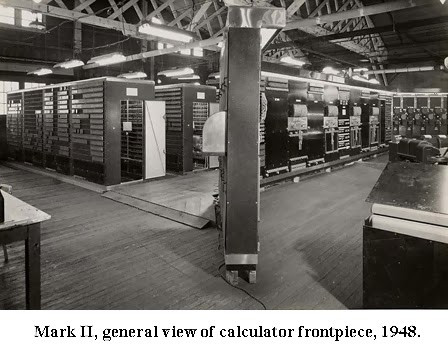
Today is the 107th birthday of one of the most important people in computing history. Grace Hopper, the Navy Rear Admiral, mathematician and computer scientist was the first ever to write a compiler (the process that converts your programs into machine language, or ones and zeros), one of the first to see computers as something other than gigantic calculators, and even coined the term 'debugging' for removing problems within a machine. Of course, it was literally debugging in her case, since a moth had flown into relay 70 of the massive - and I mean massive; that's a picture of it below and all it did were calculations since it used mechanical relays as opposed to circuits - Mark II Aiken Relay Calculator at Harvard University causing the system to experience operational problems. I have also included a picture of the bug itself, which is in the collection of the Smithsonian's Museum of American History. She admits she didn't actually find it, but her name is most often associated with it.
The above is just a small sample of her accomplishments, she really was a pioneer in the then-emerging world of computing capabilities. (One other thing that deserves mention - the site gracehopper.org, ostensibly for celebrating women in computing, never actually mentions or discusses Grace Hopper!)
![]() |
| The bug |
Subscribe to:
Posts (Atom)